
北京理工大学材料学院黄木华教授团队与华中科技大学薛志刚教授、高惠副教授团队合作,近日在共价有机框架材料(COFs)剥离研究中取得进展。相关研究成果以“In Situ Polymerization-Driven Exfoliation of COFs: A Universal Strategy Toward High-Performance Polymer Organic Cathodes ”为题在《Angewant Chemie International Edition》上发表。
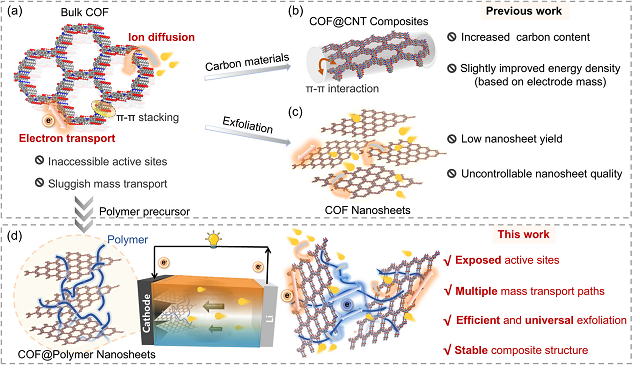
Figure 1. Schematic illustration of the strategy used to improve the electrochemical performance of bulk COFs as cathodes. (a) Performance bottleneck of bulk COFs. (b) COFs and carbon material composite strategy. (c) Strategy for exfoliating bulk COFs into nanosheets via existing exfoliation methods. (d) In situ composite strategy for polymerizing electroactive linear polymers within COFs.
虽然共价有机框架是很有前景的锂离子电池有机正极材料,但其致密的层状堆积结构限制了离子/电子的传输,导致活性位点利用率低和倍率性能差。本工作提出了一种原位复合策略:在共价有机框架孔道内聚合电活性单体。利用聚合应力和聚合物-共价有机框架相互作用来减弱层间结合力,从而将块状共价有机框架转化为具有聚合物穿插的少层纳米片(COF@Polymer)。
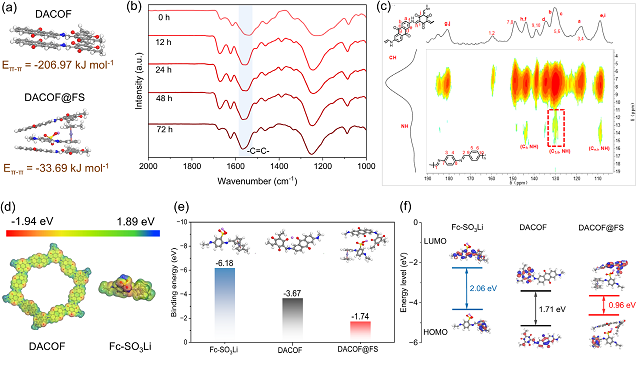
Figure 2.The exfoliation mechanism and the structure of the in situ composite. (a) Comparison of the interlayer π─πinteraction energy of DACOF and DACOF@FS calculated by DFT. (b) FT-IR spectra of the products obtained by polymerization of Fc-SO3 Li precursor solution in DACOF at different times. (c) The 2D 1H-13C HETCOR NMR spectrum of DACOF@TD (50:50 by weight). (d) Electrostatic potential distribution of DACOF and Fc-SO3 Li. (e) Binding energy between DACOF, Fc-SO3 Li, and DACOF@FS and lithium ions. (f) Energy level distribution diagram of DACOF, Fc-SO3Li, and DACOF@FS.
与传统的剥离方法相比,该方法具有更高的产率、更广泛的适用性和更好的纳米片质量。COF@Polymer正极表现出三重优势:纳米片形貌提高了活性位点的可及性并缩短了质量传输距离;穿插的聚合物建立了高效且额外的载流子传输路径;聚合物-共价有机框架相互作用增强了结构稳定性。
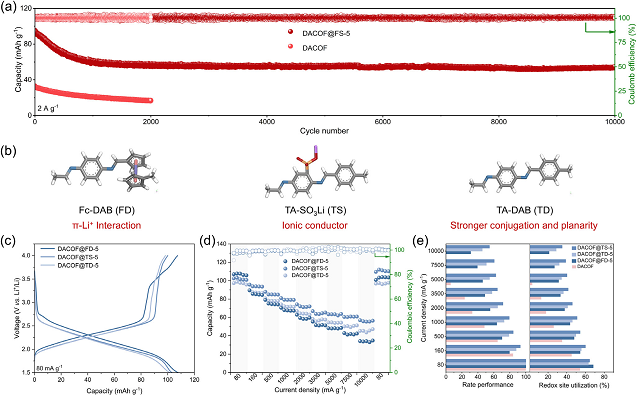
Figure 3. Structure and electrochemical properties of DACOF@Polymer system. (a) Cycling performances over 10000 cycles at 2 A g−1 for DACOF and DACOF@FS-5. (b) Structures of other polymers used in the in situ composite strategy using DACOF as the target COF (gray: C atoms; white: H; red: O; blue: N; yellow: S; purple: Li and violet: Iron). (c, d) Charge−discharge profiles at 80 mA g−1 and rate performance of DACOF@FD-5, DACOF@TS-5, and DACOF@TD-5. (e) Bar chart comparison of rate performance and active site utilization of DACOF, DACOF@FD-5, DACOF@TS-5, and DACOF@TD-5 at different current densities.
因此,COF@Polymer正极在活性位点利用率(DACOF@FS-5为95%,BTCOF@FS-20为98%,PTCOF@FS-10为92%)、倍率性能(BTCOF@FS-20和PTCOF@FS-10在10 A g−1电流密度下与0.2 A g−1时相比,容量保持率约为70%)、循环稳定性、能量密度和功率密度(BTCOF@FS-20的功率密度为30.5 kW kg−1,能量密度高达336 Wh kg−1)方面均优于原始共价有机框架、传统剥离得到的纳米片以及共价有机框架-碳复合材料。
文章链接:
Angew. Chem. Int. Ed. 2026 , e4518858 doi.org/10.1002/anie.4518858
https://doi.org/10.1002/anie.4518858


